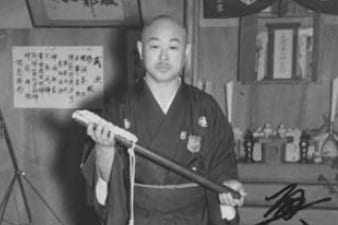

All techniques in Hakko Denshin Ryu are based on natural movements. Our founder believed all should be able to protect themselves so he designed a martial art for everyone. Because our techniques are simple, fluid and natural, great strength and flexibility is not a training requirement. It is an ideal art for women and men of all statures. As noted in our history page, the founder of Hakko Ryu studied with one of the last instructors from the Genji Samurai clan. These techniques were developed over one thousand years ago and have been battle tested for there effectiveness. Furthermore, Soke Michael LaMonica developed an intricate system of real-world applications of the principles for modern day self-defense.
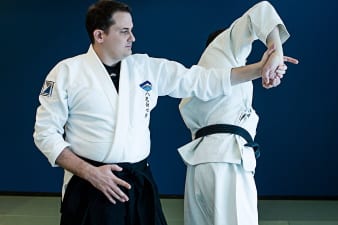
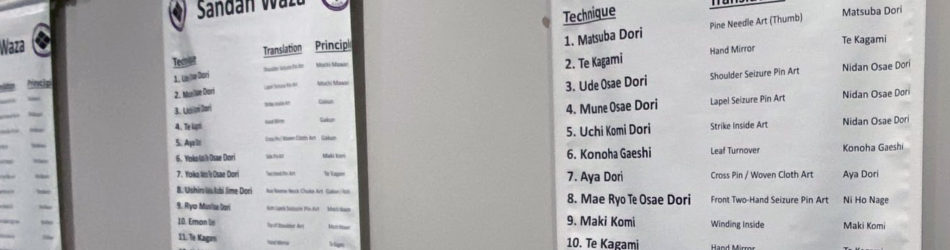
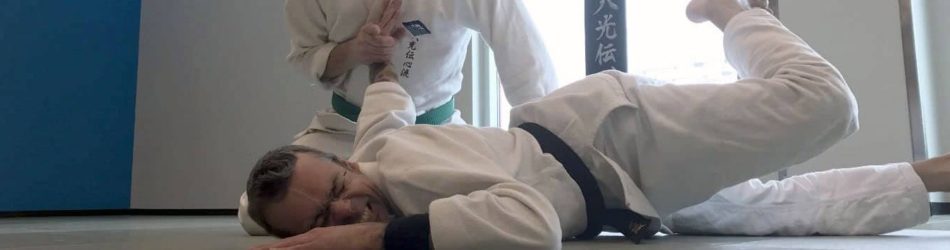
Our art can be divided into two main categories of practice: Waza (forms) and Henka (variations). Waza are done with a partner and are used to teach the principles upon which this system of self-defense is built. The relationship between training partners is a unique one. The attacker or uke (oo-kay) is responsible for giving passive resistance so that the defender or tori (toe-ree) can better understand the principle being practiced. One way we attempt to simulate “real life attacks” is by rotating partners to allow the student to experience different body types.
Henke are based on real-life attacks such as a choke, punch, or grab. Students learn to apply the waza principles in different ways so that they may be better prepared to deal with aggressions of all kinds. Relaxation is a fundamental facet of the teachings of Hakko Denshin Ryu. By training ourselves to be consciously relaxed in our classes, we become subconsciously relaxed in a real conflict.
Many of our techniques place an attacker in very compromising positions. In feudal Japan, these techniques were used to disarm a foe, render them helpless, and, in many cases, kill them. We are taught to keep a calm state of mind so that we may more accurately choose the appropriate level of response to an attacker. Soke LaMonica employs a system akin to the continuum of force used by nearly all police academies. The response to an attack should be appropriate to the level of such an attack. Hakko Denshin Ryu practitioners can easily break the limbs of an attacker or render them unconscious. However, we are taught there are only two situations in which such extreme measures are to be used: when attacked by multiple assailants or if a weapon is involved.
All in all, Hakko Denshin Ryu Ju Jutsu is a combat effective system of self-defense that can be learned, appropriately adapted and used by nearly anyone.
There are five principles found in all Hakko Denshin Ryu techniques.
Stance, balance and yielding are three principles that are all related and work in coordination with each other. By developing and having a strong stance, yielding to opponent?s strength, a practitioner can off-balance an opponent. This is the beginning of a Hakko Denshin Ryu JuJutsu defense. The combination of these three principles may be difficult to learn but through guidance, and repetitious practice a student can ingrain this philosophy into their practice and will learn to avoid using physical strength and power to over come an attack. One cannot resist non-resistance.
Gakun is a Japanese word that refers to a specific handgrip and movement. If one points toward the wall with the first finger extended and the thumb up, Gakun is the motion when the first finger moves to the floor and the little finger moves toward the elbow or the exact reverse movement of the hand and fingers. Incidentally, the Hakko Denshin Ryu grip does not rely on the first finger and it usually remains extended. Gakun is used to capture the opponent and to strengthen wrist bends. Later on in the development of a Hakko Denshin Ryu student they will learn to apply gakun as a type of atemi.
Atemi refers to light striking of the body. Hakko Denshin Ryu emphasizes striking the meridians (lines) of the body called Keiraku. The lines are the same that you find in traditional Chinese acupuncture and acupressure derived from the yin and yang theory. Many of the kihon waza or basic techniques begin or finish with light touches to the meridians. Atemi waza is not intended to be the “knock out punch” or to create a brutal physical effect. The Intention of a well-placed atemi is to distract and stun the aggressor. It is often referred to as ?softening? your opponent. Upon mastery of method the Keiraku are memorized and are struck instinctively during self-defense confrontations. Command sense would dictate that if an attack were sufficiently dangerous, a Hakko Denshin Ryu practitioner may chose to respond with a strong Atemi .
An advanced technique is a technique that uses more than one principle, a unique application of a principle or a principle from more than one degree of black belt training. With enough experience, if one technique is not effective or the attacker escapes, the experienced practitioner simply moves to a different principle that will pin the attacker. By practicing an advanced technique a Hakko Denshin Ryu practitioner develops fluidity through a wide variety to principles.